 Add to Chrome
 Add to Firefox
 Add to Edge
DAG-MoE: From Simple Mixture to Structural Aggregation in Mixture-of-Experts
May 31, 2026
Mixture-of-Experts (MoE) models have become a leading approach for decoupling parameter count from computational cost in large language models, yet effectively scaling MoE performance remains a challenge. Prior work shows that fine-grained experts enlarge the space of expert combinations and improve flexibility, but they also impose substantial routing overhead, creating a new scalability bottleneck. In this paper, we explore a complementary axis for scaling -- how expert outputs are aggregated. We theoretically show that replacing the standard weighted-summation aggregation with structural aggregation expands the expert-combination space without altering the experts or router, and enables possible multi-step reasoning within a single MoE layer. To this end, we propose DAG-MoE, a sparse MoE framework that employs a lightweight module to automatically learn the optimal aggregation structure among the selected experts. Extensive experiments under standard language modeling settings show that DAG-MoE consistently improves performance in both pretraining and fine-tuning, surpassing traditional MoE baselines.

Toward User Preference Alignment in LLM Recommendation via Explicit Context Feedback
May 27, 2026Traditional recommender systems (RecSys) primarily infer user preferences from implicit signals (such as clicks, watches, and purchases), often neglecting the rich explicit contextual feedback users provide through verbal text, like comments and reviews. This explicit context feedback captures the nuanced reasons behind user decisions regarding their preferences. In addition, it offers critical heterogeneous information for user preference alignment and more explainable recommendations. Overlooking such signals can lead to misaligned user preferences and further reinforce filter bubbles, as algorithms fail to understand the "semantic context" behind user choices. Recent advances in Large Language Models (LLMs) present new opportunities to harness user-generated content for more accurate and diverse recommendations, yet current LLM-based recommendations still focus on using item meta-data and underutilize this resource. In this paper, we advocate for prioritizing explicit context feedback in the next generation of LLM-based RecSys. We review the evolution of recommendation paradigms, highlight the value of context-rich feedback, call for new benchmarks and metrics, and introduce frameworks for integrating explicit user signals into scalable LLM-driven RecSys. Centering on user-preference modeling, we aim to foster more personalized, transparent, and explainable RecSys online platforms.
Code as Agent Harness
May 18, 2026Recent large language models (LLMs) have demonstrated strong capabilities in understanding and generating code, from competitive programming to repository-level software engineering. In emerging agentic systems, code is no longer only a target output. It increasingly serves as an operational substrate for agent reasoning, acting, environment modeling, and execution-based verification. We frame this shift through the lens of agent harnesses and introduce code as agent harness: a unified view that centers code as the basis for agent infrastructure. To systematically study this perspective, we organize the survey around three connected layers. First, we study the harness interface, where code connects agents to reasoning, action, and environment modeling. Second, we examine harness mechanisms: planning, memory, and tool use for long-horizon execution, together with feedback-driven control and optimization that make harness reliable and adaptive. Third, we discuss scaling the harness from single-agent systems to multi-agent settings, where shared code artifacts support multi-agent coordination, review, and verification. Across these layers, we summarize representative methods and practical applications of code as agent harness, spanning coding assistants, GUI/OS automation, embodied agents, scientific discovery, personalization and recommendation, DevOps, and enterprise workflows. We further outline open challenges for harness engineering, including evaluation beyond final task success, verification under incomplete feedback, regression-free harness improvement, consistent shared state across multiple agents, human oversight for safety-critical actions, and extensions to multimodal environments. By centering code as the harness of agentic AI, this survey provides a unified roadmap toward executable, verifiable, and stateful AI agent systems.
ReMix: Reinforcement routing for mixtures of LoRAs in LLM finetuning
Mar 10, 2026Low-rank adapters (LoRAs) are a parameter-efficient finetuning technique that injects trainable low-rank matrices into pretrained models to adapt them to new tasks. Mixture-of-LoRAs models expand neural networks efficiently by routing each layer input to a small subset of specialized LoRAs of the layer. Existing Mixture-of-LoRAs routers assign a learned routing weight to each LoRA to enable end-to-end training of the router. Despite their empirical promise, we observe that the routing weights are typically extremely imbalanced across LoRAs in practice, where only one or two LoRAs often dominate the routing weights. This essentially limits the number of effective LoRAs and thus severely hinders the expressive power of existing Mixture-of-LoRAs models. In this work, we attribute this weakness to the nature of learnable routing weights and rethink the fundamental design of the router. To address this critical issue, we propose a new router designed that we call Reinforcement Routing for Mixture-of-LoRAs (ReMix). Our key idea is using non-learnable routing weights to ensure all active LoRAs to be equally effective, with no LoRA dominating the routing weights. However, our routers cannot be trained directly via gradient descent due to our non-learnable routing weights. Hence, we further propose an unbiased gradient estimator for the router by employing the reinforce leave-one-out (RLOO) technique, where we regard the supervision loss as the reward and the router as the policy in reinforcement learning. Our gradient estimator also enables to scale up training compute to boost the predictive performance of our ReMix. Extensive experiments demonstrate that our proposed ReMix significantly outperform state-of-the-art parameter-efficient finetuning methods under a comparable number of activated parameters.
Verifiable Reasoning for LLM-based Generative Recommendation
Mar 08, 2026Reasoning in Large Language Models (LLMs) has recently shown strong potential in enhancing generative recommendation through deep understanding of complex user preference. Existing approaches follow a {reason-then-recommend} paradigm, where LLMs perform step-by-step reasoning before item generation. However, this paradigm inevitably suffers from reasoning degradation (i.e., homogeneous or error-accumulated reasoning) due to the lack of intermediate verification, thus undermining the recommendation. To bridge this gap, we propose a novel \textbf{\textit{reason-verify-recommend}} paradigm, which interleaves reasoning with verification to provide reliable feedback, guiding the reasoning process toward more faithful user preference understanding. To enable effective verification, we establish two key principles for verifier design: 1) reliability ensures accurate evaluation of reasoning correctness and informative guidance generation; and 2) multi-dimensionality emphasizes comprehensive verification across multi-dimensional user preferences. Accordingly, we propose an effective implementation called VRec. It employs a mixture of verifiers to ensure multi-dimensionality, while leveraging a proxy prediction objective to pursue reliability. Experiments on four real-world datasets demonstrate that VRec substantially enhances recommendation effectiveness and scalability without compromising efficiency. The codes can be found at https://github.com/Linxyhaha/Verifiable-Rec.
Text Has Curvature
Feb 13, 2026Does text have an intrinsic curvature? Language is increasingly modeled in curved geometries - hyperbolic spaces for hierarchy, mixed-curvature manifolds for compositional structure - yet a basic scientific question remains unresolved: what does curvature mean for text itself, in a way that is native to language rather than an artifact of the embedding space we choose? We argue that text does indeed have curvature, and show how to detect it, define it, and use it. To this end, we propose Texture, a text-native, word-level discrete curvature signal, and make three contributions. (a) Existence: We provide empirical and theoretical certificates that semantic inference in natural corpora is non-flat, i.e. language has inherent curvature. (b) Definition: We define Texture by reconciling left- and right-context beliefs around a masked word through a Schrodinger bridge, yielding a curvature field that is positive where context focuses meaning and negative where it fans out into competing continuations. (c) Utility: Texture is actionable: it serves as a general-purpose measurement and control primitive enabling geometry without geometric training; we instantiate it on two representative tasks, improving long-context inference through curvature-guided compression and retrieval-augmented generation through curvature-guided routing. Together, our results establish a text-native curvature paradigm, making curvature measurable and practically useful.
Don't Waste It: Guiding Generative Recommenders with Structured Human Priors via Multi-head Decoding
Nov 16, 2025Optimizing recommender systems for objectives beyond accuracy, such as diversity, novelty, and personalization, is crucial for long-term user satisfaction. To this end, industrial practitioners have accumulated vast amounts of structured domain knowledge, which we term human priors (e.g., item taxonomies, temporal patterns). This knowledge is typically applied through post-hoc adjustments during ranking or post-ranking. However, this approach remains decoupled from the core model learning, which is particularly undesirable as the industry shifts to end-to-end generative recommendation foundation models. On the other hand, many methods targeting these beyond-accuracy objectives often require architecture-specific modifications and discard these valuable human priors by learning user intent in a fully unsupervised manner. Instead of discarding the human priors accumulated over years of practice, we introduce a backbone-agnostic framework that seamlessly integrates these human priors directly into the end-to-end training of generative recommenders. With lightweight, prior-conditioned adapter heads inspired by efficient LLM decoding strategies, our approach guides the model to disentangle user intent along human-understandable axes (e.g., interaction types, long- vs. short-term interests). We also introduce a hierarchical composition strategy for modeling complex interactions across different prior types. Extensive experiments on three large-scale datasets demonstrate that our method significantly enhances both accuracy and beyond-accuracy objectives. We also show that human priors allow the backbone model to more effectively leverage longer context lengths and larger model sizes.
CRAG-MM: Multi-modal Multi-turn Comprehensive RAG Benchmark
Oct 30, 2025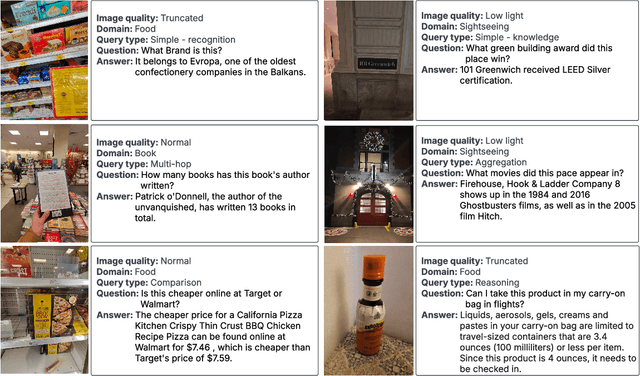
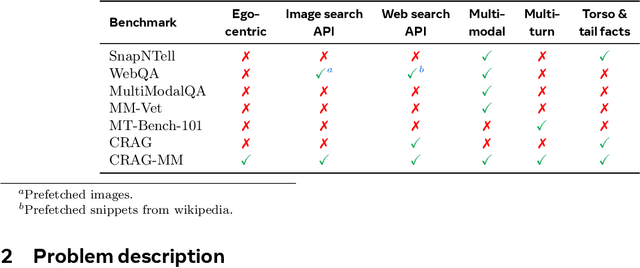
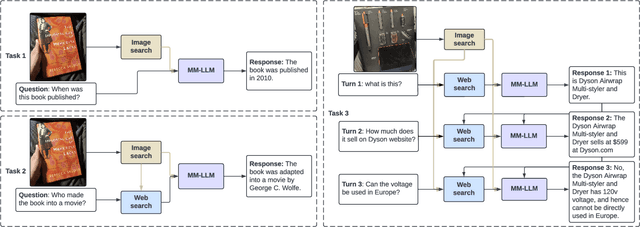
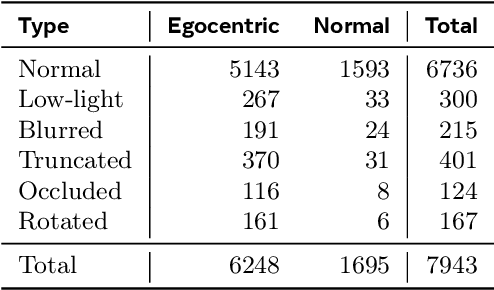
Wearable devices such as smart glasses are transforming the way people interact with their surroundings, enabling users to seek information regarding entities in their view. Multi-Modal Retrieval-Augmented Generation (MM-RAG) plays a key role in supporting such questions, yet there is still no comprehensive benchmark for this task, especially regarding wearables scenarios. To fill this gap, we present CRAG-MM -- a Comprehensive RAG benchmark for Multi-modal Multi-turn conversations. CRAG-MM contains a diverse set of 6.5K (image, question, answer) triplets and 2K visual-based multi-turn conversations across 13 domains, including 6.2K egocentric images designed to mimic captures from wearable devices. We carefully constructed the questions to reflect real-world scenarios and challenges, including five types of image-quality issues, six question types, varying entity popularity, differing information dynamism, and different conversation turns. We design three tasks: single-source augmentation, multi-source augmentation, and multi-turn conversations -- each paired with an associated retrieval corpus and APIs for both image-KG retrieval and webpage retrieval. Our evaluation shows that straightforward RAG approaches achieve only 32% and 43% truthfulness on CRAG-MM single- and multi-turn QA, respectively, whereas state-of-the-art industry solutions have similar quality (32%/45%), underscoring ample room for improvement. The benchmark has hosted KDD Cup 2025, attracting about 1K participants and 5K submissions, with winning solutions improving baseline performance by 28%, highlighting its early impact on advancing the field.
S'MoRE: Structural Mixture of Residual Experts for LLM Fine-tuning
Apr 08, 2025Fine-tuning pre-trained large language models (LLMs) presents a dual challenge of balancing parameter efficiency and model capacity. Existing methods like low-rank adaptations (LoRA) are efficient but lack flexibility, while Mixture-of-Experts (MoE) architectures enhance model capacity at the cost of more & under-utilized parameters. To address these limitations, we propose Structural Mixture of Residual Experts (S'MoRE), a novel framework that seamlessly integrates the efficiency of LoRA with the flexibility of MoE. Specifically, S'MoRE employs hierarchical low-rank decomposition of expert weights, yielding residuals of varying orders interconnected in a multi-layer structure. By routing input tokens through sub-trees of residuals, S'MoRE emulates the capacity of many experts by instantiating and assembling just a few low-rank matrices. We craft the inter-layer propagation of S'MoRE's residuals as a special type of Graph Neural Network (GNN), and prove that under similar parameter budget, S'MoRE improves "structural flexibility" of traditional MoE (or Mixture-of-LoRA) by exponential order. Comprehensive theoretical analysis and empirical results demonstrate that S'MoRE achieves superior fine-tuning performance, offering a transformative approach for efficient LLM adaptation.
Towards Trustworthy Retrieval Augmented Generation for Large Language Models: A Survey
Feb 08, 2025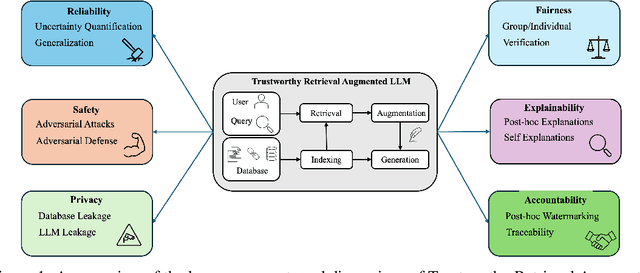
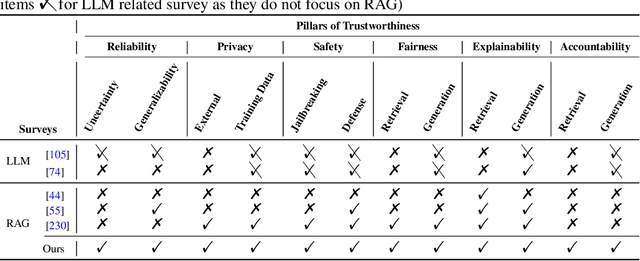
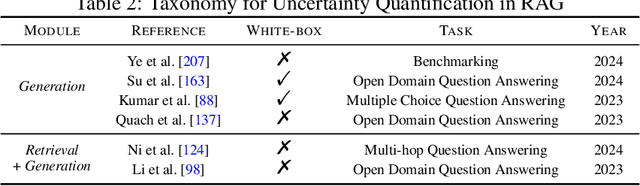
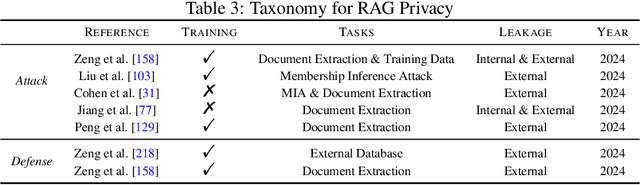
Retrieval-Augmented Generation (RAG) is an advanced technique designed to address the challenges of Artificial Intelligence-Generated Content (AIGC). By integrating context retrieval into content generation, RAG provides reliable and up-to-date external knowledge, reduces hallucinations, and ensures relevant context across a wide range of tasks. However, despite RAG's success and potential, recent studies have shown that the RAG paradigm also introduces new risks, including robustness issues, privacy concerns, adversarial attacks, and accountability issues. Addressing these risks is critical for future applications of RAG systems, as they directly impact their trustworthiness. Although various methods have been developed to improve the trustworthiness of RAG methods, there is a lack of a unified perspective and framework for research in this topic. Thus, in this paper, we aim to address this gap by providing a comprehensive roadmap for developing trustworthy RAG systems. We place our discussion around five key perspectives: reliability, privacy, safety, fairness, explainability, and accountability. For each perspective, we present a general framework and taxonomy, offering a structured approach to understanding the current challenges, evaluating existing solutions, and identifying promising future research directions. To encourage broader adoption and innovation, we also highlight the downstream applications where trustworthy RAG systems have a significant impact.